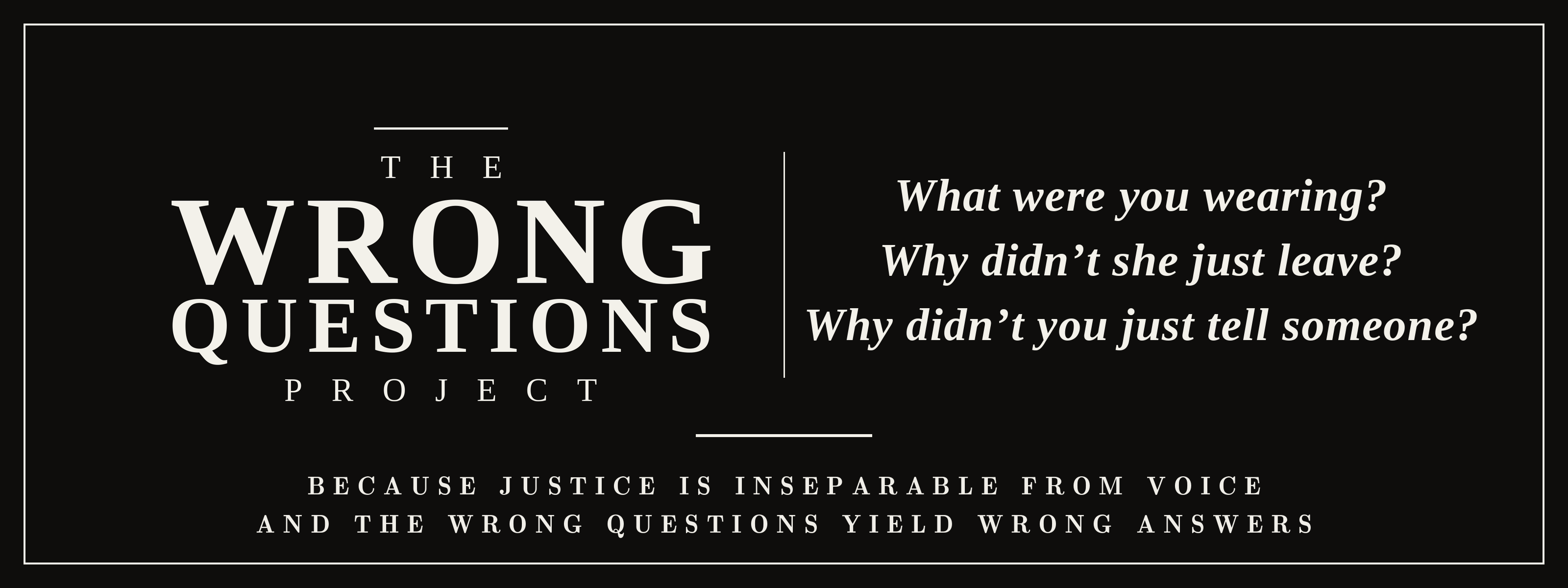
The Wrong Questions Project

An educational intervention to expose and upend victim-blaming. We reveal how victim-blaming questions protect perpetrators and blame survivors. Through exhibits, podcasts, films, and educational work, we document child sexual abuse, domestic violence, and gender-based violence—and the institutional failures that enable these harms.

About The Project

Victim-Blaming Questions

The Wrong Questions Project exposes three central victim-blaming questions:

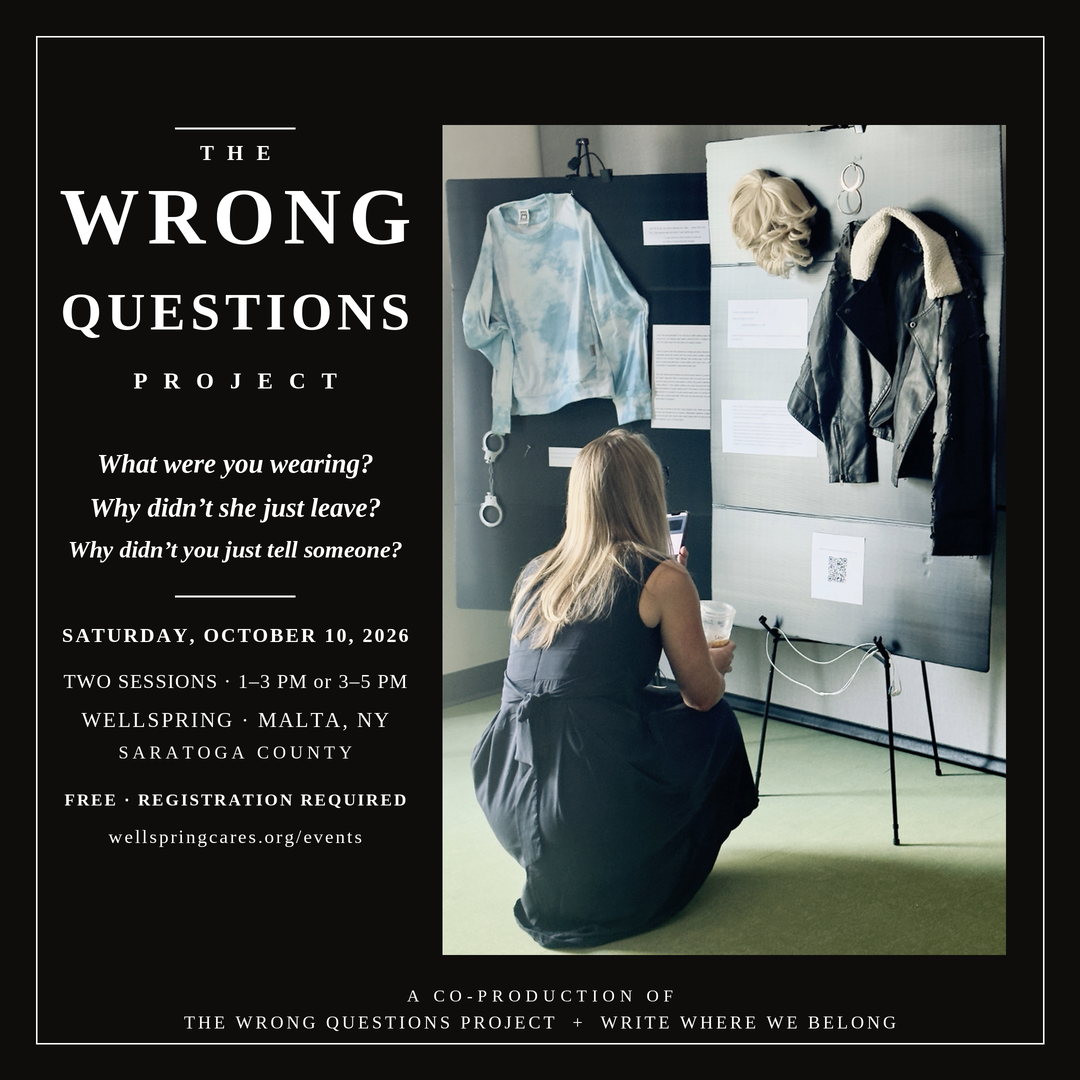
  • "What were you wearing?" — The question that blames victims for gender-based violence by treating clothing as explanation.
  • "Why didn't she just leave?" — The question that ignores coercive control, danger, and institutional failure in domestic violence.
  • "Why didn't you just tell someone?" — The question that treats silence as the problem rather than examining what happens when children do speak.

These questions are not innocent curiosities. They are accusations that redirect responsibility from perpetrators to victims, survivors, and families. They make the person harmed answer for violence they did not cause. The Wrong Questions Project reveals how these questions function as tools of institutional disbelief and how they enable violence to continue.

Our Mission

The Wrong Questions Project is a dedicated to creating educational interventions that exposes and upends victim-blaming. Founded by Mary Simmerling, PhD, whose poem "What I Was Wearing" explored the victim-blaming questions that enable violence and institutional failure. Through "What Were You Wearing?" exhibits, podcasts, documentary films, educational presentations, and other work, we reveal how victim-blaming questions function as tools that protect perpetrators while blaming survivors—documenting child sexual abuse, domestic violence, and gender-based violence, and the institutional failures that enable these harms.

Because justice is inseparable from voice, and the wrong questions yield wrong answers.

How We Work

Our educational intervention prioritizes survivor voice, institutional accountability, and the exposure of how disbelief functions as a tool of systemic harm. The exhibits are powerful tools that support and illustrate this work—they ground our analysis in specific cases, evidence, and survivor testimony to reveal how victim-blaming questions protect perpetrators. By exposing these patterns, we upend victim-blaming and challenge the language and structures that enable violence while shifting responsibility to where it belongs: with perpetrators and the institutions that protect them.

The Modular Exhibit Framework

"What Is It You're Asking?"

The Wrong Questions Project's signature framework is a modular system of exhibits that can be installed individually, in combination, or as a fully integrated installation. Each module begins with a victim-blaming question and traces how that question functions to blame survivors and enable violence.

The exhibits are not illustrations or artistic interpretations. They are documentation. The clothing, words, objects, statistics, case records, audio, video, testimony, and family witness are part of the evidence. They are placed together so that what has been normalized, minimized, laundered, and administratively absorbed can be seen clearly.

Module 1: "What Were You Wearing?"

The Role of Victim-Blaming & Indifference in Facilitating & Perpetuating Gender-Based Crimes

This module confronts how victim-blaming questions treat clothing as explanation for sexual violence. The question redirects scrutiny from perpetrator to victim, making the person harmed answer for violence they did not cause.

This module pairs survivor words, representative clothing, contextual data, documentary records, and evidence to challenge the false narrative that victims cause, invite, or fail to prevent gender-based violence.

Module 2: "Why Didn't She Just Leave?"

Documenting the Violence That Prevents Women from Leaving the Men Who Abuse Them

This module dismantles the question that treats leaving as a simple decision. It documents the violence that makes leaving dangerous: coercive control, stalking, threats, surveillance, and institutional failures that leave women unprotected.

This module centers survivors of domestic violence and surviving family members when violence became lethal, examining not only violence inside relationships but institutional responses: police, courts, custody decisions, media narratives, and institutional refusal to act.

Module 3: "Why Didn't You Just Tell Someone?"

The Question Is Not Why Children Do Not Tell. The Question Is What Happens When They Do.

This module examines how the question fails children by treating silence as the problem rather than examining adults, institutions, and systems that failed to listen, recognize, investigate, intervene, or protect.

This module brings grooming into view—not just of children, but of families and institutions. It examines how authority becomes a grooming environment, how trust is exploited, reputations protected, and access preserved for perpetrators.

How the Framework Functions

When modules are installed together, they amplify one another and reveal the shared machinery: grooming, coercion, silencing, disbelief, institutional failure, credibility policing, victim-blaming, record-management, and the normalization of harm.

Once these patterns become visible in one setting, they become visible everywhere: in police reports, clergy files, hospitals, schools, family courts, custody decisions, media narratives, and the boardrooms where institutions decide whose accounts will be believed and whose will not.

Educational Presentations

The Wrong Questions Project offers educational presentations and workshops designed to help institutions, organizations, and communities understand how victim-blaming questions function as tools of institutional disbelief and harm.

Institutional Workshops

For universities, hospitals, law enforcement, and social service organizations seeking to understand how victim-blaming questions and institutional indifference function across their systems and affect survivors.

Duration: 60-90 minutes | Audience: Staff, leadership, and institutional decision-makers

Educational Seminars

For students, educators, and community members interested in understanding how the infrastructure of disbelief operates and how to build systems that center survivor truth and accountability.

Duration: Variable | Audience: Students, educators, community organizations

Professional Development

For professionals in victim advocacy, legal services, trauma-informed care, and institutional accountability seeking deeper understanding of victim-blaming as a systemic practice.

Duration: 90-120 minutes | Audience: Professional practitioners and advocates

Interested in Bringing a Presentation to Your Organization?

We work with institutions and organizations to design presentations that meet your specific needs and context. Contact us to discuss your educational goals.

Video & Media

The Wrong Questions Project on YouTube

Subscribe to our YouTube channel to watch documentary films, short videos, and educational content about the victim-blaming questions that fail survivors and perpetuate violence. Our video series brings together survivor testimony, institutional analysis, and documentary evidence.

Each video explores how specific victim-blaming questions function across different forms of violence—child sexual abuse, domestic violence, and gender-based violence—and traces these questions through the institutions and systems that fail survivors.

Watch Our Content

Visit our YouTube channel to explore documentary films, educational videos, and survivor-centered content that exposes the patterns and architecture of violence.

The Wrong Questions Project on YouTube

Documentary Series

Our work spans multiple formats to reach diverse audiences:

  • Documentary short films
  • Educational video series
  • Survivor testimony and interviews
  • Institutional analysis and explanation
  • Books and publications

Get In Touch